
location:
size:
status:
year:
credits:
collaborators:
construction:
photos:
Athens, Greece
115m2
completed
2025
John Karahalios
Elisavet Plaini
Nikos Labrou
Grade Engineering
Nikos Papageorgiou

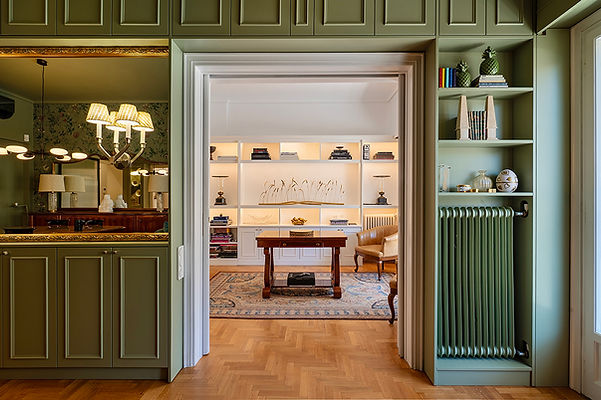


The project concerns the renovation of a 115 sq.m. apartment in Kolonaki, located in an urban apartment building dating back to the 1950s. The architectural approach is based on preserving the original floor plan, which is characterized by a dense subdivision of rooms—a defining feature of post-war urban residential typologies in Athens.
Interventions to the layout are limited and focus primarily on the kitchen and WC areas, aiming to improve functionality while maintaining the overall spatial structure. The apartment is organized into clearly defined rooms, each treated as an autonomous spatial entity with its own chromatic and material identity.
White acts as a neutral background in the entrance hall and the study, emphasizing the transition from public to private space. The living area is rendered in green tones, inspired by the wallpaper, retaining its distinct character within the sequence of rooms.
The kitchen is redesigned through a combination of white, beige, and black materials, forming a space that is both restrained and domestic. The WC is entirely clad in green Tinos marble, resulting in a space with a strong material presence and an almost monochromatic expression.
Within the private zone of the apartment, the children’s bedroom is articulated in pink hues and incorporates custom-built structures for the bed, transforming furniture into an integral architectural element. The main bedroom, defined by blue tones, includes a built-in daybed that resolves storage issues and creates new functions.
The bathroom is divided into two distinct zones: the washbasin area, finished in black tiles, and the toilet and bathtub area, in white tiles, enhancing contrast and functional hierarchy.
The primary architectural intention was to highlight the existing spatial logic of the apartment, reinforce the autonomy of each room, and construct a coherent narrative through color and bespoke built-in elements. The result is a residence that responds to contemporary needs by constructing a memory of a 1950s apartment through subtle yet meaningful interventions.

Plan


popaganda.gr
posted January 24, 2026

Open House Athens
April 4-5, 2026

iefimerida.gr
posted April 5, 2026